The Life of a Sugarcane Fiber
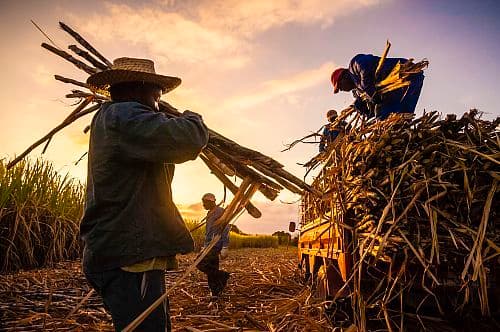
Sugarcane is one of the world's most efficient plants for capturing solar energy and carbon. However, for every 10 tons of sugar produced, roughly 3 tons of 'bagasse'—the fibrous pulp leftover after crushing—is generated. Traditionally, this was burned, releasing CO2 back into the atmosphere. The science of bagasse manufacturing solves two problems at once: it prevents waste burning and replaces plastic.
Understanding the molecular structure of these fibers is the key to why products from DineX Ecopack perform so differently from standard 'paper' plates.
1. The Molecular Structure: Cellulose & Lignin
Bagasse fibers are composed primarily of cellulose, hemicellulose, and lignin. This natural trio provides the 'skeletal' strength to the sugarcane stalk, allowing it to grow up to 6 meters tall. In our refining process, we preserve the natural lignin—which acts as a moisture-resistant 'glue'—to enhance the plate's structural integrity without adding chemical cross-linkers.

2. The 'Chemical-Free' Barrier Science
One of the breakthrough areas of our research has been 'PFAS-Free' oil resistance. PFAS (per- and polyfluoroalkyl substances) were the traditional way manufacturers made paper resistant to grease, but they are 'forever chemicals' that don't belong near food. The DineX R&D team has developed a mechanical refining technique that closes the 'pores' of the fiber web so tightly that oil cannot penetrate, even without synthetic coatings.
3. Lifecycle Analysis (LCA) Data
Science allows us to quantify the environmental benefit. When we compare the 'Cradle-to-Grave' impact of a DineX plate vs. a Polystyrene plate:
- Carbon Footprint: 85% lower than plastic.
- Water Usage: 60% lower than traditional wood-paper production (which requires heavy bleaching).
- Energy Consumption: 40% lower throughout the industrial molding process.
"True innovation in 2026 is about creating products that perform perfectly for their 30-minute 'active life' but leave no molecular trace behind for the next 300 years."
4. The Decomposition Curve
The science doesn't stop after the meal. Our bagasse products are engineered to be 'biological nutrients'. Within a controlled composting environment (55-60°C), the microbes begin breaking down the cellulose bonds within 14 days. By day 60, the material has reverted to nutrient-rich biomass. This is a scientific miracle compared to the 400-year degradation cycle of synthetic polymers.
5. Summary of Scientific Advantage
DineX Ecopack isn't just selling 'eco' plates; we are selling the product of decades of material science research. Our fibers are stronger, safer, and faster to disappear—because they are built in harmony with biology, not in opposition to it.